Skip to content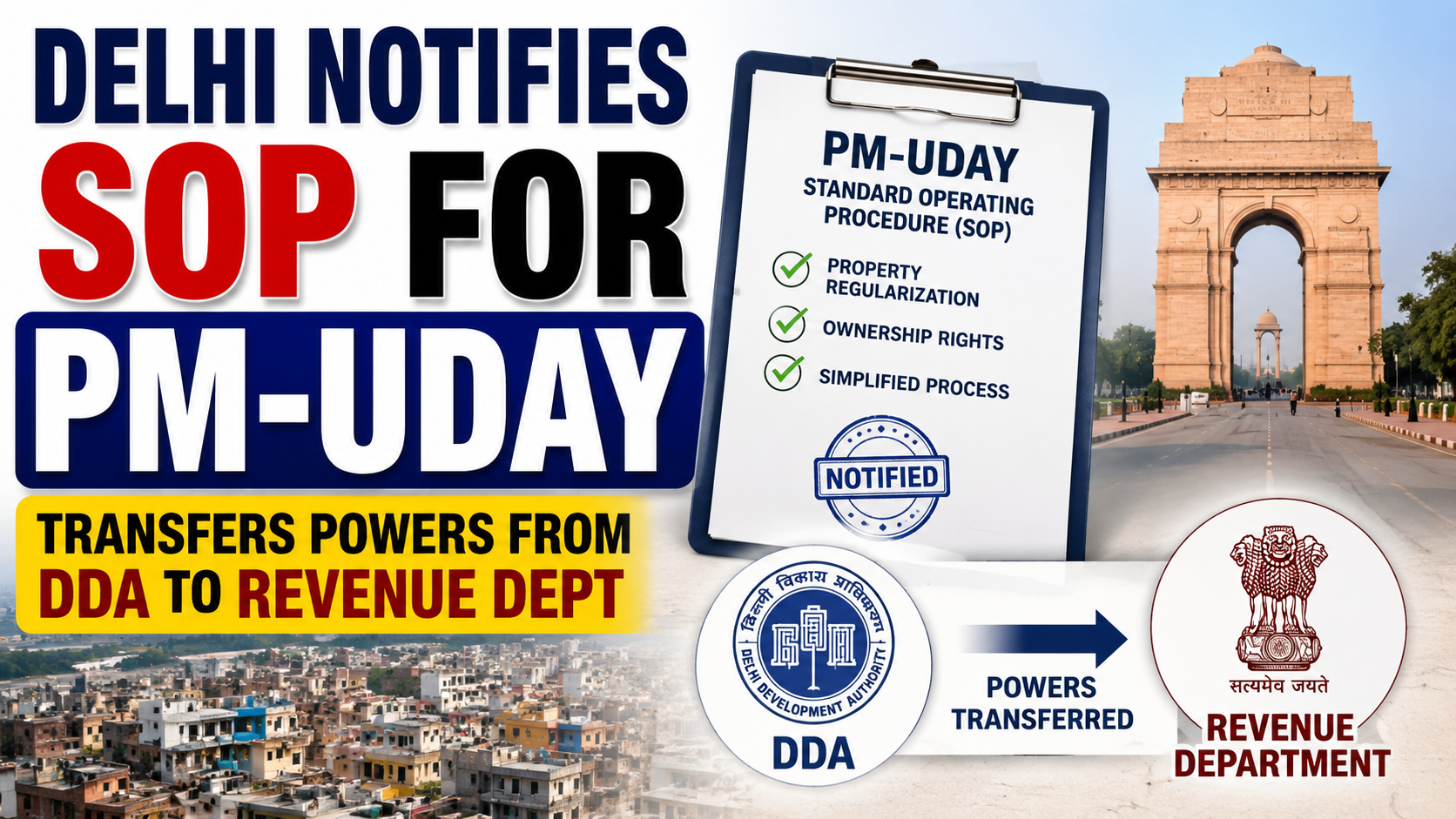
For millions of Delhi residents living in unauthorised colonies, the word ‘regularisation’ has been a promise dangled and deferred for more than two decades. Papers were filed, queues were joined, and hopes were raised — only to be met with bureaucratic dead ends, missing layout plans, and an ever-growing pile of procedural hurdles. But something shifted in April 2026, and this time, the ground beneath those long-frustrated feet seems a little more solid.
The Delhi government has officially notified a comprehensive Standard Operating Procedure (SOP) for the PM UDAY scheme — Pradhan Mantri Unauthorised Colonies in Delhi Awas Adhikar Yojana — alongside a decisive structural change: the powers to issue conveyance deeds and authorisation slips, which previously rested with the Delhi Development Authority (DDA), have now been transferred to the Revenue Department of the Government of NCT of Delhi. The Municipal Corporation of Delhi (MCD) will step in to issue regularisation certificates on the back of those documents, completing a three-pronged institutional arrangement designed to finally push this long-stalled process across the finish line.
It is a bureaucratic reshuffle that sounds dry on paper. But for a first-generation homeowner in Sangam Vihar, a shopkeeper in Uttam Nagar, or a tenant-turned-owner in Burari who has spent years without a registered title deed, this notification is anything but dry. It is the difference between owning a home and merely occupying one.
Why Unauthorised Colonies Became Delhi’s Most Persistent Urban Problem
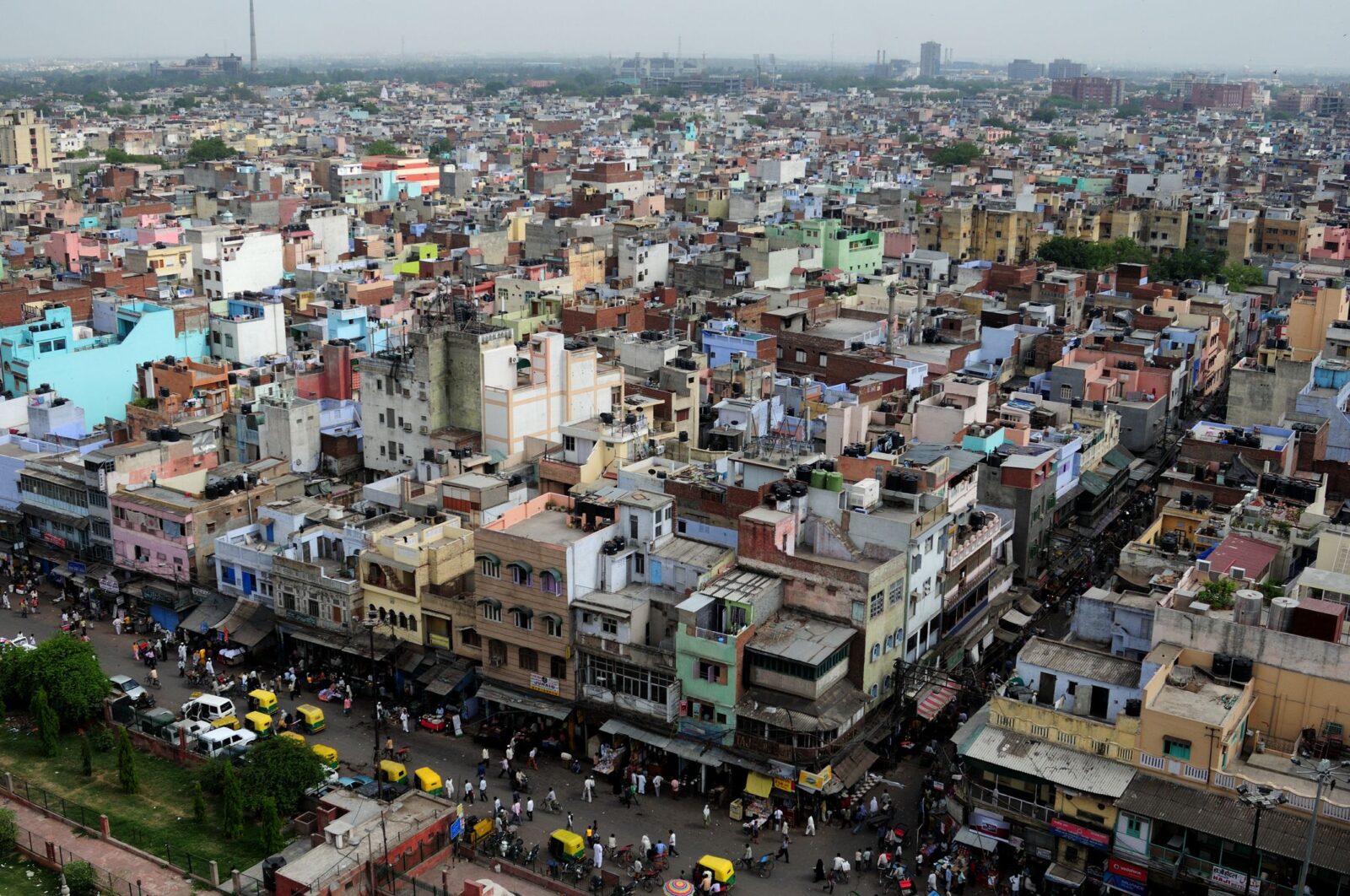
Delhi grew faster than anyone planned for it. Successive waves of migration — partition refugees, economic migrants, seasonal workers who became permanent settlers — transformed the city’s edges into a patchwork of informal settlements. By the time planners caught up, over 1,700 unauthorised colonies had taken root across the capital, housing an estimated 40 to 45 lakh people.
In these colonies, properties changed hands through General Power of Attorney (GPA) documents, Agreements to Sell, payment receipts, and possession letters — instruments that are legally thin and practically fragile. Banks refused to extend home loans against them. Sub-registrars would not register them. Building plans could not be approved. And the residents, many of whom had paid fair market value for their homes, lived with the perpetual anxiety that the state could challenge their occupancy at any point.
Governments tried to address this over the decades. A press note in 1961 laid the earliest groundwork. The 2008 Regulations attempted a more systematic approach, assigning the GNCTD the task of delineating colony boundaries — a task that remained incomplete for eleven years, with the government seeking extensions until 2021. The colonies kept growing; the problem kept compounding.
PM-UDAY: The 2019 Scheme That Changed the Framework
The Union Cabinet approved the PM-UDAY framework in 2019, notifying the National Capital Territory of Delhi (Recognition of Property Rights of Residents in Unauthorised Colonies) Regulations on 29 October 2019, followed by the Act in December of the same year. The scheme set out to confer ownership, transfer, and mortgage rights to residents of 1,731 identified unauthorised colonies. It excluded 69 colonies classified as ‘affluent’ — defined on the basis of plot size, location, and level of development.
The DDA was tasked with running the scheme. Ten processing centres and seventeen extended offices were set up across the city. Boundaries were delineated using satellite imagery from 2015, in coordination with the Survey of India and the Revenue Department. The entire application process was moved online through the PM-UDAY portal, with GIS survey firms empanelled to generate geo-coordinates and key plans for each property.
On paper, the scheme was ambitious and well-structured. In practice, it moved slowly. By early 2025, the DDA had issued approximately 40,000 conveyance deeds — a number that sounds significant until you consider that the total estimated number of property-owning residents in unauthorised colonies runs to roughly ten lakh. The pace was not matching the scale of the problem.
The April 2026 Reset: What Actually Changed
On 7 April 2026, Union Minister Manohar Lal and Delhi Chief Minister Rekha Gupta jointly announced a new policy for regularising properties across 1,521 unauthorised colonies. The announcement confirmed a structural overhaul — not just a procedural nudge — of how the regularisation machinery would work going forward.
The most consequential change is the transfer of document-issuing authority. Under the earlier arrangement, the DDA issued conveyance deeds for properties on government land and authorisation slips for properties on private land. Under the new system, this role passes to the Revenue Department of the Delhi government. The MCD will then issue regularisation certificates based on these documents. And property owners who hold regularisation certificates can register their titles through the National Generic Document Registration System (NGDRS) portal.
Applications for ownership rights and regularisation certificates will be accepted through the MCD’s SWAGAM portal from 24 April 2026. The SWAGAM portal will, in turn, direct applicants to the PM-UDAY portal for those who still need to obtain a conveyance deed or authorisation slip. All three portals — SWAGAM, PM-UDAY, and NGDRS — are designed to work as a coordinated online system, so that a resident does not have to physically shuttle between three separate government offices.
The process applies on an ‘as is where is’ basis. What this means in practical terms is that the absence of an approved layout plan — which had previously been one of the biggest bottlenecks — will no longer block regularisation. Existing built-up structures are eligible as they stand, without requiring the property to conform to a pre-approved blueprint.
The SOP: District-Level Machinery and ADM Oversight
The Delhi government has readied a detailed SOP and submitted it for approval by the competent authority. The SOP envisages a district-wise implementation model, with Additional District Magistrates (ADMs) serving as nodal officers across all 13 districts. Each district will have a dedicated staff of five to six employees tasked with processing conveyance deed and authorisation slip applications received through the SWAGAM portal.
This is a meaningful design choice. The DDA is a centralised agency; its processing centres, while numerous, could not replicate the local knowledge and accessibility of district-level governance. By placing ADMs at the helm of the regularisation cells, the government is betting that district administration — which already handles land records and revenue matters — is better placed to resolve property disputes, verify ownership chains, and issue documents in a timely manner.
Chief Minister Rekha Gupta has framed this shift in terms of dignity. Speaking at the announcement, she noted that residents of unauthorised colonies had long felt like second-class citizens. They had paid for their land, built their homes, raised their families — and yet could not prove ownership in court or walk into a bank for a loan. The new policy is intended to change that basic equation.
Guarding Against New Encroachments: The Drone Monitoring Mechanism
Regularisation without a monitoring mechanism carries its own risks. Once colonies are formally recognised, there is the danger that opportunistic actors will attempt to extend boundaries, add illegal floors, or create new unauthorised structures under the assumption that a future regularisation drive will bail them out. The government has factored this concern into the new framework.
The MCD will undertake bi-monthly AI-based drone surveys of each of the 1,521 colonies. The surveys are designed to detect any new construction that has not been sanctioned and to generate an evidence trail that authorities can act on swiftly. The use of AI-assisted analysis on drone imagery is a recognition that physical inspection of over 1,500 colonies at regular intervals is not operationally feasible without technological support.
It is an approach that signals intent as much as capacity. Whether the drone monitoring programme will have the enforcement teeth needed to deter violations will depend on how consistently the data is acted upon. But its inclusion in the framework at the outset is noteworthy.
Who Benefits — and Who Does Not
The new policy covers 1,521 of the over 1,700 unauthorised colonies in Delhi. Two hundred and twenty colonies are excluded from this regularisation drive. The exclusions apply to colonies located in protected zones — notified forests, the Ridge, Yamuna flood plains, and areas around ancient monuments — as well as the 69 ‘affluent’ unauthorised colonies that were carved out from the original PM-UDAY framework in 2019.
For those within the 1,521 regularisable colonies, the benefits are concrete and cascading. Legal ownership means the ability to sell, purchase, and transfer properties without the risks that attend GPA-based transactions. It means being able to walk into a bank with a title deed and apply for a home loan or a mortgage. It means building plan approvals become possible, allowing residents to legally expand, renovate, or redevelop their properties. And it means access to better civic infrastructure — roads, drains, water supply — which local bodies can now plan and invest in with the confidence that these are formally recognised urban settlements.
For residents who have already received conveyance deeds or authorisation slips from the DDA under the earlier process, those documents remain valid. The approximately 40,000 deeds issued previously are not being recalled or invalidated. However, property owners who have not yet obtained these documents will now need to apply through the SWAGAM portal, which will route them to the PM-UDAY portal if required.
Challenges That Cannot Be Wished Away
The optimism around the new SOP and the institutional restructuring is warranted. But it would be naive to overlook the challenges that earlier governments also faced — and which this framework must navigate more successfully.
Property documents in unauthorised colonies are notoriously tangled. Multiple transactions over decades, conducted through unregistered or notarised instruments, create chains of ownership that can be difficult to verify. GPA holders, will-based claimants, and registered sale deed holders may all claim the same property. The ADM-led district cells will need robust adjudication protocols to resolve disputes without creating fresh grievances.
The staffing model — five to six employees per district — is lean given the volume of pending applications. Out of an estimated ten lakh property owners, fewer than 40,000 have so far completed the process. Even if the new system is significantly more efficient, processing hundreds of thousands of applications while maintaining accuracy and fairness will require sustained administrative focus and, likely, additional capacity.
Digital literacy also remains an uneven variable. The entirely online process is efficient in design, but residents in older or more economically vulnerable parts of the city may struggle to navigate the portals without assistance. The common service centres (CSCs) and help desks established under PM-UDAY have played a useful facilitation role in the past and will need to be strengthened further under the new framework.
What This Means for Delhi’s Real Estate Market
Beyond the humanitarian dimension, the regularisation drive has tangible implications for Delhi’s property market. Unauthorised colonies account for a significant slice of the city’s residential stock — in some areas, they are the dominant form of housing. Bringing these properties into the legal fold will affect valuations, transaction volumes, and developer interest.
Properties that receive title deeds tend to see appreciation in value, as the legal certainty removes the discount buyers and lenders attach to informal ownership. Mortgage availability will increase the pool of effective buyers. Building plan approvals will make redevelopment economically viable, potentially catalysing a wave of construction activity in densely built-up but structurally ageing colonies.
Investors and developers have already been paying attention. The formalisation of South Delhi’s unauthorised colonies in particular — areas with good connectivity and established commercial activity — is expected to draw structured real estate capital into neighbourhoods that were previously considered too legally precarious to underwrite.
A Long Time Coming — But the Work Is Not Done
The notification of the SOP and the transfer of powers from the DDA to the Revenue Department represent a genuine administrative course-correction. The earlier system was not broken in its intent — PM-UDAY was a well-designed scheme — but its execution was strained by the DDA’s centralised structure, the complexity of individual cases, and the procedural requirement for layout plans that many colonies simply did not have.
The new framework addresses several of those friction points directly. The ‘as is where is’ eligibility criterion removes the layout plan barrier. The district-level cells bring decision-making closer to the ground. The three-portal integration reduces the number of offices a resident must physically visit. And the Revenue Department’s deeper familiarity with land records makes it arguably a more natural home for this function than the DDA.
What remains is the harder part: implementation. An SOP is a document until it becomes a habit. The district cells need to be staffed, trained, and held accountable. The portals need to be maintained and made genuinely accessible. The dispute resolution mechanisms need to be fair and fast. The drone monitoring data needs to translate into actual enforcement.
For the 45 lakh residents who have waited — some of them for most of their adult lives — the notification of the SOP is a real and meaningful step forward. The promise of a patta, a deed, a document that says ‘this is yours’ is not a small thing. It is the beginning of economic security, creditworthiness, and a full stake in the city they already call home. Whether that promise is kept at scale will be the real test of this policy reform in the months and years ahead.
Disclaimer – reference taken from – https://www.hindustantimes.com/cities/delhi-news/delhi-notifies-sop-for-pm-uday-transfers-powers-from-dda-to-revenue-dept-101778784910239.html